
NEW YORK CITY · PHOTO SPOTS
The Best Instagram Spots in New York City
Start with 10 signature New York frames, then explore 78 more photo locations across all five boroughs — with original Instagram examples, portrait ideas and a numbered map.
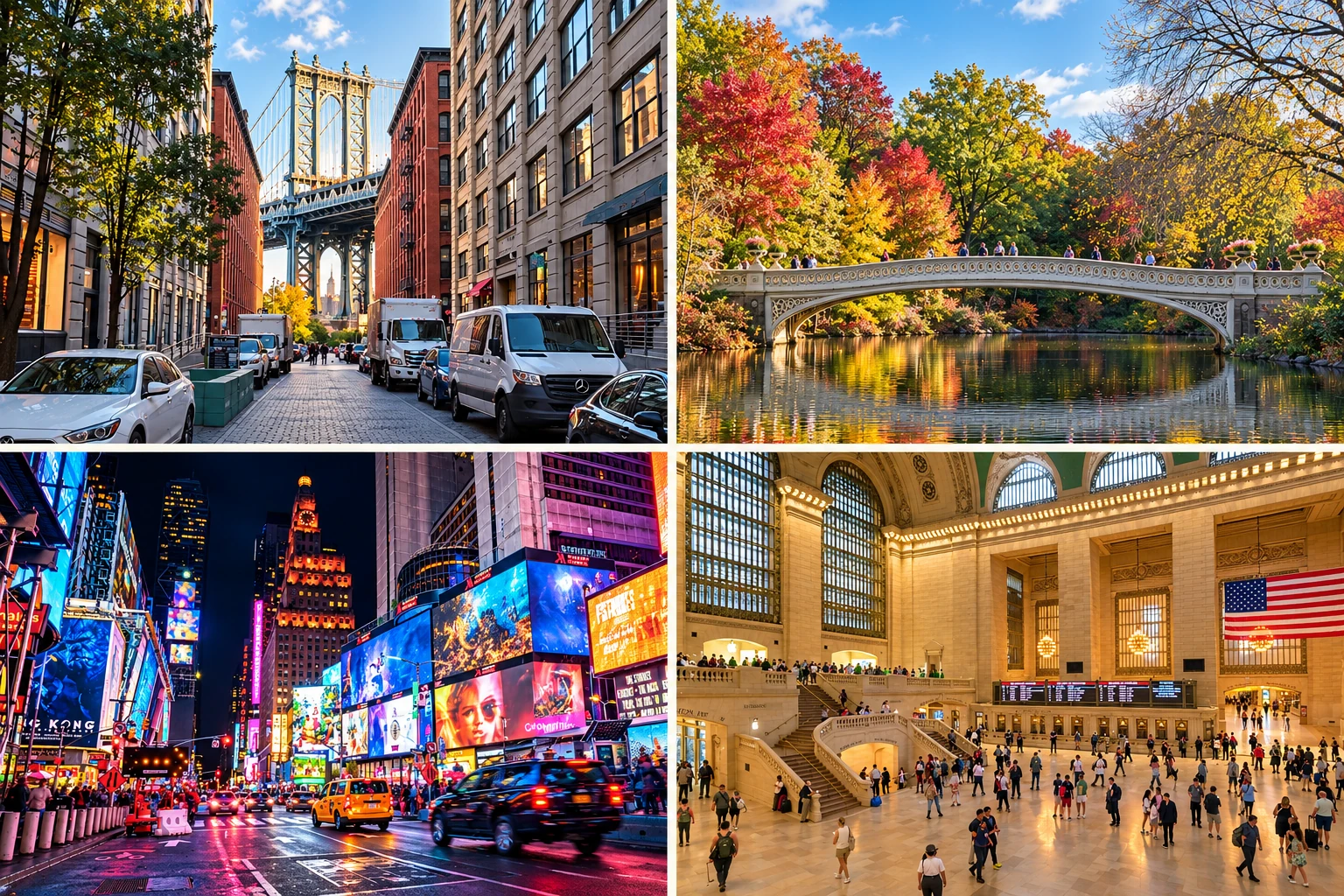
The best New York photograph is not always at the biggest attraction. It might be a quiet curve in the Village, a painted wall in Queens, a backlit ferry window or a small figure beneath the Oculus’s white ribs. Start with the kind of picture you want, then build a route around a few nearby places.
Begin with our TOP 10: the most recognizable New York settings paired with memorable photographs. After those ten, discover 78 more places across Manhattan, Brooklyn, Queens, the Bronx and Staten Island. Every chapter includes original inspiration, a portrait idea, a camera position, suggested light and its own Google Maps link.
TOP 10: signature New York photographs
These are our first choices for a photo collection that immediately feels like New York: bridge-framed streets, the skyline, park architecture, neon and dramatic interiors. The ranking balances the photograph itself with the character of its setting.
1. Washington Street: Manhattan Bridge view · 2. Top of the Rock · 3. Brooklyn Bridge pedestrian walkway · 4. Bethesda Terrace and Arcade · 5. Grand Central Terminal · 6. Times Square and the red steps · 7. Flatiron Building · 8. The Oculus · 9. Bow Bridge · 10. SUMMIT One Vanderbilt
Use the arrows inside Instagram carousels to explore every photograph. All additional examples remain below their main frame; unavailable posts have a direct original link. Older displays, aerial views and videos are identified where relevant.
1. Washington Street: Manhattan Bridge view
DUMBO, Brooklyn
The red warehouse walls create a narrow frame around the Manhattan Bridge; the distant Empire State Building can sit inside its arch. Use a longer phone lens and adjust your position rather than stretching everything with an ultrawide lens.
Best time of day
Early morning for gentler light on the bridge and a better chance of working around crowds. The street can remain busy at any hour. In strong sun, keep the face in even open shade rather than letting a bright strip cross it.
What to notice: The brick walls give a walking portrait depth, while the bridge remains the unmistakable backdrop. Notice the hands-in-pockets pose and the separation between the head and bridge opening.
Try this portrait
Use the wide sidewalk near Front Street. Turn your shoulders slightly, put one hand in a coat pocket and take a small step toward the photographer, looking toward the brighter side of the street. The selected portrait uses this relaxed styling; keep your own pose entirely on the sidewalk, with both feet on the ground.
Where to put the camera: Start on the Washington Street sidewalk at Front Street and point north toward Water Street and the Manhattan Bridge. Work from the same sidewalk as the person, about 3–5 metres away, at waist-to-chest height with the main 1× camera. Leave the tower above the head. A centered road-axis view differs from this safe sidewalk version; do not step into traffic to force symmetry.
Another frame: Make an architectural vertical with the red-brick walls as a frame and the bridge tower high in the picture. From the sidewalk, accept an off-center perspective rather than blocking a crossing.
Washington Street: Manhattan Bridge view in Google Maps →
More angles & original examples
2. Additional original example
3. Additional original example
4. Additional original example
2. Top of the Rock
Midtown Manhattan
Use the Empire State Building as the main skyline landmark, leaving room for the layers of buildings around it. Compare the different deck levels before settling on your composition.
Best time of day
Morning is useful for a clearer portrait setup, while late afternoon through blue hour offers changing light and city illumination. Visibility, cloud and crowd conditions can matter more than a nominal sunset time.
What to notice: The small pink-clad figure provides a focal point while almost the whole frame belongs to the city. The Empire State Building stays clear of the person's outline.
Try this portrait
On an open south-facing deck, stand a safe distance inside the barrier with your back or one shoulder toward the camera. Take a slow step, then pause and look toward the skyline. Keep the figure low in the composition, leaving the Empire State Building unobstructed. Do not sit on or lean over the barrier.
Where to put the camera: Aim south toward the Empire State Building. The photographer can use the next open public level up while the person stays on the lower terrace, as the example's elevated framing suggests. Use 1×, keep the skyline level and avoid placing the face near the edge. Agree on the pose before separating and never enter closed levels or staff areas.
Another frame: Make a skyline-only 2× composition around the Empire State Building, then turn north for Central Park as a completely different view. Glass reflections vary by level and angle.
Top of the Rock in Google Maps →
More angles & original examples
2. Additional original example
3. Additional original example
3. Brooklyn Bridge pedestrian walkway
Brooklyn–Lower Manhattan
Stone towers and converging suspension cables give this walk a different composition from bridge photographs taken from the shore. Keep the nearest tower central, then turn toward Manhattan for a skyline portrait.
Best time of day
Soon after sunrise, when the low eastern light can illuminate the Manhattan-facing view and the promenade may be less crowded. Blue hour is an alternative for skyline lights, but a moving portrait is harder in dim light.
What to notice: A full-length portrait keeps the stone tower and skyline visible while the railing draws the eye into the frame. The person stands on the pedestrian deck rather than sitting on the structure.
Try this portrait
Stand beside the pedestrian railing, safely inside the walkway, with your body a quarter turn toward the camera. Rest your hands lightly, soften one knee and look back toward the photographer. Keep both feet on the deck for a steadier version of the example; never climb or sit on the bridge structure.
Where to put the camera: From the Brooklyn half of the elevated pedestrian walkway, face generally west toward the Manhattan-side tower and skyline. Step 3–4 metres back along the same walkway, use the 1× camera at chest height and place the person just off the tower's centerline. Check the cable lines before shooting and stop briefly only where pedestrians can pass.
Another frame: Without a person, center the two Gothic arches and use the deck boards as leading lines. For a closer portrait, a modest 2× view can simplify the cables if there is room to step back safely.
Brooklyn Bridge pedestrian walkway in Google Maps →
More angles & original examples
Keep both feet on the walkway. Use the cables and tower as references without copying poses seated on the railing.
2. Additional original example
3. Additional original example
4. Bethesda Terrace and Arcade
Central Park
Photograph through the arcade toward the open terrace, using the arches as a frame. The tiled ceiling also works as a detail photograph without relying on a working fountain.
Best time of day
Morning for softer light outside and a better chance of short gaps in pedestrian traffic. Stand near the open arches for a face portrait, where daylight reaches the subject. Deep inside, expose carefully to retain both the ceiling and the bright openings.
What to notice: A side-on walking portrait leaves the patterned ceiling and three arches readable. The bright staircase beyond separates the person from the architecture; notice the space above her head.
Try this portrait
Stand inside the lower arcade, clear of the stair entrance. Turn side-on and take two small, slow steps across the frame, looking in the direction of travel and letting one arm swing naturally. Pause between passing pedestrians. The example’s walking movement works with comfortable shoes too; the ceiling supplies the drama.
Where to put the camera: From the fountain-facing half of the lower arcade, point south toward the stairs leading to the Mall. Keep the photographer roughly 4–6 metres from the subject, at waist height with a vertical 1× frame. Place the person below the central arch and leave generous ceiling space. Keep stairs and the passage open; shoot during a gap rather than stopping traffic.
Another frame: Turn north for a ceiling-and-arches view toward the fountain terrace. Current fountain works can alter that background; the south-facing staircase portrait avoids depending on running water.
Bethesda Terrace and Arcade in Google Maps →
More angles & original examples
2. Bethesda Arcade ceiling
3. Bethesda Fountain before restoration
4. Bethesda Arcade tilework
5. Grand Central Terminal
Midtown East
From a public staircase or balcony, combine the concourse clock with the celestial ceiling. A wider frame shows the room; a tighter one isolates the movement of travelers.
Best time of day
Daylight outside weekday commuter peaks, or a weekend morning, for a balance of window light and manageable movement. The hall is indoors, so compare the light on the face with the bright windows before choosing your exact position.
What to notice: The person stands in front of the balustrade with both feet on the landing. Her small scale lets the great windows, celestial ceiling and busy concourse remain the main setting.
Try this portrait
On the public east staircase landing, stand in front of the balustrade, facing the photographer. Rest both hands lightly behind you, cross one ankle loosely in front of the other and turn your face to the side. Keep both feet on the landing and leave the stair route clear. Do not sit on the stone railing.
Where to put the camera: Use the public east staircase landing, looking west across the information clock toward the three tall windows. Stand roughly 3–4 metres from the subject with a vertical 1× frame at chest height. Place the person low enough to retain the ceiling and windows, and wait for a brief gap beside the staircase rather than blocking commuters.
Another frame: From the concourse floor, make a closer photograph of the four-faced clock with the ceiling above it. Use a steady handheld frame, allowing people to move through instead of spreading equipment around the information booth.
Grand Central Terminal in Google Maps →
More angles & original examples
2. Additional original example
3. Additional original example
6. Times Square and the red steps
Midtown Manhattan
At blue hour, include a strip of remaining sky so the screens do not become the only bright element. Use a stable position in the pedestrian plaza and let the crowd form part of the scene.
Best time of day
Blue hour for a colored sky and illuminated signs, or daylight if a naturally lit face is the priority. The selected example is a daylight portrait. After dark, watch for changing screen colors on skin and wait for a softer, more neutral patch of light.
What to notice: A neutral coat and relaxed crossed-leg stance keep the subject clear against vivid signs. The bollards create a leading line while the person stays on the sidewalk.
Try this portrait
Choose a wide public sidewalk or pedestrian plaza, well inside the bollards. Stand with one foot crossing lightly in front of the other, one hand in a coat pocket and your face turned toward the open sky. Keep the shoulders loose and the pose brief so people can pass.
Where to put the camera: For a similar corridor of signs, begin on the east-side sidewalk by Broadway and West 42nd Street and face north toward the illuminated crossroads. Move within the pedestrian area until the changing signs sit behind, rather than through, the head. Use a vertical 1× frame from chest height, roughly 2–3 metres away; check face exposure before the brightest sign.
Another frame: From the public plaza around Duffy Square, look south for a wider picture of the illuminated crossroads. If the red steps are open, photograph from a permitted standing position without blocking their circulation.
Times Square and the red steps in Google Maps →
More angles & original examples
Use the lights and architecture as references; make portraits in pedestrian space rather than the traffic lanes.
2. Additional original example
3. Additional original example
7. Flatiron Building
Flatiron District
The narrow wedge-shaped facade is particularly effective in a vertical composition. Photograph from the pedestrian plaza north of the building and keep the full roofline within the frame.
Best time of day
Morning or late afternoon; adjust to shadows.
What to notice: A low viewpoint pairs a full-length figure in dark clothing with the Flatiron’s narrow prow. The tower remains readable above the person.
Try this portrait
On the pedestrian plaza north of 23rd Street, put one foot forward, turn your shoulders toward the tower and look upward. Let one arm make a loose gesture while keeping the silhouette clear of the building’s prow.
Where to put the camera: From the pedestrian plaza at Broadway and Fifth Avenue north of East 23rd Street, face south toward the building. Use a vertical 1× frame from waist height, 3–4 metres from the person, leaving room for the whole tower.
Another frame: Make the person-free architectural view shown below, or try a closer portrait with the tower rising behind one shoulder.
Flatiron Building in Google Maps →
More angles & original examples
2. Additional original example
3. Additional original example
8. The Oculus
Lower Manhattan
White ribs, long sightlines and the central hall create one of Downtown’s clearest architectural compositions. Try a centered interior view from a publicly accessible upper level, then a low exterior angle that separates the white ribs from the surrounding towers.
Best time of day
Quiet weekday morning; daylight for the interior.
What to notice: The white ribs converge above a small side-facing figure, leaving the architecture dominant.
Try this portrait
Stand inside the upper-level railing, turn side-on toward the hall and let your hands rest naturally. Leave the ribs visible above and around your outline.
Where to put the camera: From the publicly open upper concourse beside the central hall, face along the ribbed interior toward its far end. Stand 3–4 metres from the person with a vertical 1× frame at chest height; use the nearest railing as a diagonal.
Another frame: Outside, compare a low view of the white ribs against the surrounding towers.
More angles & original examples
2. Additional original example
3. Oculus and One World Trade Center at night
9. Bow Bridge
Central Park
From the lakeside path, include the entire arch and its reflection when the water is still. On the bridge, photograph along the curved railing rather than stopping in the middle of the walkway.
Best time of day
Early morning for gentler light and a chance of calmer water. In autumn, check the actual foliage conditions rather than fixing a date from an old photograph. Overcast light can be flattering for a portrait; reflections depend on wind and boat activity.
What to notice: The pale railings lead toward a small turning figure, while the trees fill the upper frame. Published by @tourdelust, with photography credited in the original post to @jerometraveller.
Try this portrait
Near one end of the bridge, pause with one foot slightly forward and turn the shoulders toward the photographer. A light movement of a skirt or coat adds life, but keep the gesture small and give pedestrians priority. No special outfit is needed: a relaxed walking step works equally well.
Where to put the camera: Start at the southern, Cherry Hill end and aim generally north along the deck toward the Ramble. Keep the camera near waist height, use a vertical 1× view and stand several paces from the subject so both railings lead into the picture. Shift a little if a branch or urn merges with the head; do not block the bridge while waiting for an empty background.
Another frame: Follow the open lakeside path near Cherry Hill and photograph the bridge side-on, including its arch and water. Stay behind any barriers and accept a partial reflection when conditions are breezy.
More angles & original examples
2. Additional original example
3. Additional original example
10. SUMMIT One Vanderbilt
Midtown Manhattan
Balance a recognizable skyline detail with the mirrored floor. Lower the camera carefully to emphasize the reflection, then try a portrait with fewer people behind the subject.
Best time of day
Daylight for reflections; sunset for warmer skyline tones.
What to notice: Reflective silver balloons surround a side-facing figure beside the skyline windows, combining a portrait with the city beyond.
Try this portrait
In the Affinity room, stand beside a clear window area, turn side-on toward the skyline and look slightly upward. Keep your hands relaxed and leave the balloons space around your head.
Where to put the camera: From inside SUMMIT’s Affinity room, face your companion and the skyline-facing windows. Stand 2–3 metres away with a vertical 1× camera at chest height, including silver balloons above and beside the figure without blocking the walkway.
Another frame: In the mirrored Air rooms, use the repeated skyline and your reflected outline for the different composition shown below.
SUMMIT One Vanderbilt in Google Maps →
More angles & original examples
2. Additional original example
78 more photo spots across New York City
Keep exploring beyond the first ten. The rest of this guide is grouped by neighborhood, from harbor views and Village streets to Brooklyn murals, Queens waterfronts and gardens in the Bronx and Staten Island. This citywide selection is independent of our TOP17 attractions list.
Find your neighborhood and frame
Downtown architecture & the harbor
11. One World Observatory · 12. Brookfield Place and the Winter Garden · 13. Stone Street · 14. New York Stock Exchange and Fearless Girl · 15. Charging Bull · 16. The Battery: waterfront and gardens · 17. Pier 17 Riverdeck · 18. Fulton Street at South Street Seaport · 19. Statue of Liberty and Liberty Island · 20. Governors Island: The Hills and Hammock Grove · 21. Staten Island Ferry
Tribeca, SoHo, Nolita & the Village
22. Staple Street Skybridge · 23. SoHo’s cast-iron streets · 24. Doyers Street · 25. Mulberry Street and the Audrey Hepburn mural · 26. Pietro Nolita · 27. Sézane’s New York boutique · 28. Museum of Ice Cream — New York · 29. Gay Street · 30. Friends apartment exterior at Bedford and Grove · 31. Washington Square Arch · 32. Stuyvesant Street
Chelsea, Hudson Yards & the Empire State Building
33. Chelsea Market · 34. The High Line · 35. Whitney Museum terraces · 36. Little Island · 37. Pier 57 Rooftop Park · 38. Vessel · 39. Edge at Hudson Yards · 40. Empire State Building
Midtown streets, skyline & interiors
41. Bryant Park · 42. New York Public Library — Stephen A. Schwarzman Building · 43. Tudor City Bridge · 44. Rockefeller Center: plaza, Channel Gardens and Atlas · 45. St. Patrick’s Cathedral · 46. Radio City Music Hall · 47. The Museum of Modern Art (MoMA) · 48. The Morgan Library & Museum
Central Park, museums & northern Manhattan
49. Gapstow Bridge and The Pond · 50. Sheep Meadow · 51. The Mall and Literary Walk · 52. Belvedere Castle · 53. Conservatory Garden · 54. The Metropolitan Museum of Art steps · 55. Solomon R. Guggenheim Museum · 56. Albertine Books · 57. Gilder Center at the American Museum of Natural History · 58. The Met Cloisters · 59. Little Red Lighthouse
Roosevelt Island
60. Roosevelt Island Tramway · 61. Franklin D. Roosevelt Four Freedoms State Park
Brooklyn neighborhoods & waterfronts
62. Pebble Beach · 63. Jane’s Carousel · 64. Old Pier 1: East River pile fields · 65. Time Out Market New York rooftop · 66. Brooklyn Heights Promenade · 67. Hudson Avenue in Vinegar Hill · 68. 1 Hotel Brooklyn Bridge · 69. Domino Park · 70. Westlight at The William Vale · 71. Marsha P. Johnson State Park · 72. Bushwick Inlet Park · 73. WNYC Transmitter Park · 74. The Bushwick Collective · 75. Industry City courtyards and murals · 76. New York Transit Museum · 77. Brooklyn Botanic Garden · 78. Coney Island Boardwalk and Wonder Wheel
Queens
79. Gantry Plaza State Park · 80. Pepsi-Cola sign at Gantry Plaza · 81. Hunters Point South Park · 82. Socrates Sculpture Park · 83. Welling Court Mural Project · 84. Unisphere, Flushing Meadows Corona Park · 85. TWA Hotel at JFK
The Bronx & Staten Island
86. New York Botanical Garden — Enid A. Haupt Conservatory · 87. Wave Hill gardens and pergola · 88. Snug Harbor: Chinese Scholar’s Garden and Cottage Row
Back to TOP 10 · Shared map · Photo routes · Light & portraits · Sources
Map of all 88 photo locations
Numbers 1–10 are our signature frames; 11–88 match the rest of the guide. Pins mark useful starting places rather than the exact camera position of every photograph. Zoom in or choose a location from the list, then use its chapter for framing and camera direction.
Open the full-screen New York photo map →
11. One World Observatory
Lower Manhattan
The elevated view makes the harbor, bridges and tightly packed streets read as a single cityscape. Wear dark clothing to reduce reflections and keep the lens close to the glass without blocking other visitors.
Best time of day
Clear afternoon into sunset; choose visibility over a particular time.
What to notice: The two East River bridges, dense street grid and strip of water give the panorama several readable layers.
Try this portrait
Stand a step back from a southeast-facing window, turn one shoulder toward the camera and look across the river. Keep the body beside, rather than over, the main bridge in the background.
Where to put the camera: Use the southeast-facing observation windows toward Brooklyn Bridge and Manhattan Bridge. For the landscape, hold the lens close to the glass without touching it; for a portrait, move 2–3 metres back and frame at chest height. Dark clothing helps reduce reflections.
Another frame: Make a tighter 2× view of the bridge spans, keeping the horizon level.
One World Observatory in Google Maps →
More angles & original examples
2. Additional original example
12. Brookfield Place and the Winter Garden
Lower Manhattan
The glass atrium, palms and nearby waterfront give this stop a different mood from the surrounding streets. Use the atrium’s curve as the frame and position a person away from the center to show its scale.
Best time of day
Daylight for the atrium; late afternoon on the waterfront.
What to notice: The glass vault, palms and curved staircase create strong symmetry. The colorful hanging installation is a historical display, not a permanent feature.
Try this portrait
On a broad open landing, stand a little off the middle and turn toward the palms, with one foot forward and arms relaxed. Keep the staircase circulation clear.
Where to put the camera: From the upper Winter Garden landing, look across the atrium toward the glass vault and palms. Use a vertical 1× frame from chest height, including the arc of the staircase below; keep a person small within the architecture.
Another frame: Turn toward the waterfront and use the atrium windows as a frame for the river.
Brookfield Place and the Winter Garden in Google Maps →
More angles & original examples
2. Additional original example
13. Stone Street
Financial District
A short pedestrian setting with textured paving, brick facades and outdoor restaurant tables. Look along the street rather than across it; the curve and rows of buildings provide depth.
Best time of day
Morning for fewer tables in use; evening for restaurant lights.
What to notice: Warm restaurant lights lead down the narrow street beneath the brick facades. The transparent dining domes belong to an older seasonal setup.
Try this portrait
Stand on an open pedestrian margin beside the restaurant frontage, turn a shoulder toward the brighter lights and take one slow step. Keep diners and entrances clear of your setup.
Where to put the camera: From the pedestrian stretch of Stone Street near Hanover Square, look along the building corridor toward Broad Street. Use a vertical 1× frame from chest height; place your companion 3 metres away beside the facade, not inside restaurant seating.
Another frame: In daylight, concentrate on the textured paving and repeating brick windows without depending on seasonal decorations.
More angles & original examples
2. Additional original example
14. New York Stock Exchange and Fearless Girl
Financial District
The columns of the exchange and the small bronze figure offer contrasting scales in the same public streetscape. Photograph from the public pedestrian space and leave room for the building above the statue.
Best time of day
Early morning; holiday lighting only when installed.
What to notice: The back-facing person gives the exchange facade scale, while the flag and columns dominate the upper frame.
Try this portrait
In the pedestrian area of Broad Street, face the exchange and put your hands lightly on your hips or hold a coat low. Turn your head a little toward one shoulder, leaving the facade above you.
Where to put the camera: From Broad Street opposite the exchange, point west toward its columns. Photograph your companion from 3–5 metres behind with a vertical 1× view. Shift sideways to include Fearless Girl separately; the selected portrait itself emphasizes the building.
Another frame: Make a lower frame of Fearless Girl with the exchange rising above, keeping people’s outlines clear of the statue.
New York Stock Exchange and Fearless Girl in Google Maps →
More angles & original examples
2. Seasonal lights on Wall Street
15. Charging Bull
Financial District
A recognizable street sculpture that can be photographed as part of the Financial District walk. Try a side angle that includes the surrounding street, with enough space around the horns.
Best time of day
Early morning.
What to notice: The low frontal angle gives the bronze horns and shoulders a strong outline against the street.
Try this portrait
Stand to one side of the sculpture, entirely within the pedestrian space, and angle your shoulders toward it. Keep hands relaxed and leave a clear gap around the horns; do not climb the bronze.
Where to put the camera: From the public space at Bowling Green, work from a stationary position near the bull’s front, then move sideways for a portrait. Hold the 1× camera around waist height and leave the horns inside the frame; avoid letting them appear to grow out of a person’s head.
Another frame: Use a side view to show the sculpture’s full body and the surrounding Financial District architecture.
Charging Bull in Google Maps →
More angles & original examples
2. Additional original example
16. The Battery: waterfront and gardens
Lower Manhattan
Combine a harbor foreground and distant Statue of Liberty with shaded woodland and garden paths. Use a longer focal length for the statue; a wide-angle phone shot works better when the promenade becomes part of the composition.
Best time of day
Late afternoon in clear conditions.
What to notice: Overhanging foliage frames a distant Statue of Liberty above a quiet band of harbor water.
Try this portrait
Use an open section of promenade beside the railing. Face the harbor, turn one shoulder toward the camera and rest one hand lightly on the rail, keeping the statue separate from your head.
Where to put the camera: From The Battery’s harbor-facing promenade, look southwest toward Liberty Island. For the broad composition, use 1× at chest height with leaves at the top. For the statue itself, try 2× or a longer optical lens; digital zoom will not recreate a close island view.
Another frame: Turn inland for a portrait framed by the garden paths and seasonal planting.
The Battery: waterfront and gardens in Google Maps →
More angles & original examples
2. The Battery Woodland
17. Pier 17 Riverdeck
South Street Seaport
An accessible waterfront perspective on the Brooklyn Bridge, with seasonal installations that sometimes add a foreground. Keep the bridge unobstructed and use the railing as a leading line rather than cutting through the subject.
Best time of day
Morning or blue hour.
What to notice: The illuminated Brooklyn Bridge runs diagonally above the river, with enough dark water to show its reflections.
Try this portrait
Stand inside the riverdeck railing, turn halfway toward the bridge and glance back at the photographer. Keep the figure away from the bridge towers and hold the pose still in low light.
Where to put the camera: From the river-facing deck at Pier 17, face north to northeast toward Brooklyn Bridge. Use a horizontal 1× frame at chest height for the bridge, or a vertical frame from 3 metres behind your companion. Keep the rail low so it does not cross the face.
Another frame: Make a tighter composition around one illuminated tower rather than depending on temporary installations.
Pier 17 Riverdeck in Google Maps →
More angles & original examples
The pumpkin arch is an older seasonal display. The bridge and waterfront are the lasting subjects.
2. Pumpkin Arch — October 2021
18. Fulton Street at South Street Seaport
South Street Seaport
The cobbled street corridor lets historic storefronts frame One World Trade Center in the distance. From the pedestrian portion of Fulton Street, look west and align the tower between the buildings.
Best time of day
Late afternoon, depending on shadows and weather.
What to notice: The historic facades create a narrow corridor around One World Trade Center, combining old streetscape and a distant tower.
Try this portrait
Use the pedestrian part of Fulton Street near Front Street. Walk slowly beside a facade and look back toward the open light, leaving the distant tower unobstructed.
Where to put the camera: From Fulton and Front Streets, point west along Fulton toward One World Trade Center. Keep the photographer and person within the pedestrian area, 3–5 metres apart, and use a vertical 1× or modest 2× view. Accept an off-center angle when traffic or deliveries occupy a crossing.
Another frame: Photograph the storefront details and paving from the same pedestrian section for a closer neighborhood frame.
19. Statue of Liberty and Liberty Island
New York Harbor
Close views of the monument, island landscaping and the original torch inside the museum allow several different compositions. Include a person or trees for scale; from inside the museum, watch for reflections around the original torch.
Best time of day
An early available ferry departure in clear weather.
What to notice: A low upward view uses spring blossom as a frame around the statue and torch. Blossom is seasonal; the monument remains the fixed subject.
Try this portrait
On an open island path, stand well in front of the monument with one shoulder turned toward it. Look upward and keep both hands low so the statue’s silhouette stays clear.
Where to put the camera: From the public grounds below the statue, point upward toward the torch. Use a vertical 1× frame and step back to keep the monument within it. For a portrait, place the person 3–4 metres away and shift until their head does not overlap the crown.
Another frame: Without blossoms, frame the statue with open sky or the island’s trees rather than seeking the exact seasonal branch.
Statue of Liberty and Liberty Island in Google Maps →
More angles & original examples
2. Additional original example
3. Additional original example
20. Governors Island: The Hills and Hammock Grove
New York Harbor, Manhattan
The Hills offer a harbor composition with open foreground and distant city towers. Continue to Hammock Grove for a completely different photograph, using the suspended hammocks and trees as the main subject. The linked examples deliberately show these two separate areas of the island.
Best time of day
Late afternoon for side light on the grassy slopes and warmer harbor views.
What to notice: The grassy slope and small people on the crest make the height of The Hills easy to read.
Try this portrait
Stand on an open path below or beside the crest, turn toward the harbor and let your arms rest naturally. Keep the person small; the sloping landscape is the subject.
Where to put the camera: From a lower public path at The Hills, look up toward the ridge with a horizontal 1× frame. For a harbor portrait, move to an open viewpoint and reverse the camera toward the water, keeping your companion inside the path boundary.
Another frame: In Hammock Grove, use an available hammock and the trees for a distinct, closer composition; avoid walking through planting to force an angle.
Governors Island: The Hills and Hammock Grove in Google Maps → · Hammock Grove in Google Maps →
More angles & original examples
2. Hammock Grove — official post
21. Staten Island Ferry
New York Harbor / Lower Manhattan and Staten Island
Use the ferry crossing for a layered view of Lower Manhattan, or include the boat’s windows and orange structure to make the journey part of the image. The skyline reference below was taken from the water, so it is not a fixed viewpoint at the terminal.
Best time of day
Late afternoon into blue hour, allowing for the ferry timetable.
What to notice: The ferry window frames the distant Statue of Liberty, with passengers providing scale and the boat’s interior identifying the journey.
Try this portrait
At a clear window or open passenger viewing area, turn toward the harbor with one hand resting naturally beside you. Keep the statue visible beyond your shoulder and give other passengers space.
Where to put the camera: On a Manhattan-to-Staten Island crossing, look from the right/starboard side toward Liberty Island; on the return, use the left/port side. For a distant statue, use a modest optical zoom and hold steady. A vertical 1× portrait can include the boat’s window frame instead of promising a close-up.
Another frame: Look back toward Lower Manhattan for a broad skyline, keeping a strip of ferry structure to identify the journey.
Staten Island Ferry in Google Maps →
More angles & original examples
2. Sunset from the ferry
22. Staple Street Skybridge
Tribeca
The suspended bridge gives this narrow street a distinctive upper frame. Keep both building edges in the picture so the bridge reads as a connection; avoid photographing from a moving traffic lane.
Best time of day
Morning or soft overcast daylight.
What to notice: The diagonal sidewalk view shows the skybridge, brick walls and fire escapes without requiring a person to stand in the road. Photograph credited to @annabeej by @nyctourism.
Try this portrait
Stand on the public sidewalk below and to one side of the bridge, turn toward your companion and take a small step together. Keep both people close to the facade and leave the road clear.
Where to put the camera: From the Harrison Street end of Staple Street, face south toward the skybridge and Jay Street. Stay on the same sidewalk as the subject, 3–5 metres away, and use a vertical 1× frame with the bridge above the heads. A sidewalk angle is more diagonal than a road-center composition.
Another frame: Crop into the bridge windows and neighboring fire escapes for a person-free architectural detail.
Staple Street Skybridge in Google Maps →
More angles & original examples
Use the bridge and brickwork as composition references. Make portraits from the sidewalk rather than copying poses in the roadway.
2. Additional original example
3. Additional original example
23. SoHo’s cast-iron streets
SoHo
Layered facades, storefronts and street details suit both architectural photographs and environmental portraits. Use the sidewalk for long views down Broadway, then explore nearby Greene Street for a different scale. The map marks a starting point, not an exact geotag for every linked post.
Best time of day
Morning or late afternoon for gentler light along the façades. In the middle of a bright day, use open shade beside the buildings and keep both the person and nearby wall in similar light. Direct sun can leave distracting bright and dark bands across a face.
What to notice: Pale cast-iron columns create a repeating sidewalk frame, with walkers adding scale and 56 Leonard at the far end. The photograph shows that a recognizable SoHo composition is possible from the pavement.
Try this portrait
On the public sidewalk, pause beside a simple stretch of façade without blocking a shop entrance. Turn one shoulder toward the photographer, hold a jacket or bag naturally and look along the block. Take a slow walking step for a second frame, with the building line continuing behind you.
Where to put the camera: For the example’s sidewalk perspective, begin beside the pale columns at 102 Greene Street, between Prince and Spring Streets, and face south toward 56 Leonard. Keep the photographer and person on the same sidewalk, roughly 3–5 metres apart. Use a vertical 1× frame from chest height, keeping the columns along the left and the distant tower clear. Do not obstruct the boutique entrance. The map pin at Broome Street is a nearby starting point; walk north along Greene to this exact composition.
Another frame: Crop out most of the street and photograph a rhythm of windows and fire escapes. A vertical detail from the opposite public sidewalk is useful when parked vehicles spoil a wider view.
102 Greene Street, SoHo in Google Maps →
More angles & original examples
2. Additional original example
24. Doyers Street
Chinatown
The bend in the street creates a layered view of restaurant signs and facades. Compose around the curve and give people enough room to move through the frame naturally.
Best time of day
Morning or bright overcast weather for softer face light and fewer competing shadows. At midday, look for even shade; an umbrella can cast a strong color onto skin. For a separate street scene, blue hour can balance illuminated signs with the remaining daylight.
What to notice: The couple’s eye contact and hands give the photograph its focus. Dark brickwork and the bright yellow umbrella form a simple frame; the location’s small details matter more than a distant landmark.
Try this portrait
If public seating is available, sit opposite one another at the same small table and turn your knees slightly toward the photographer. Lean in a little, rest hands naturally on the table and look at each other. Keep the doorway visible behind, without blocking it. Furniture, umbrellas and frontage can change; do not rearrange a business’s seating or occupy it without permission.
Where to put the camera: For the example’s intimate setting, look toward the Chinese Opera House frontage around 5–7 Doyers Street. From the public plaza, stand roughly 2–3 metres from the table, at seated eye height, and use a vertical 1× or modest 2× view. Frame the couple against the dark doorway with an umbrella edge above. If seating is unavailable, make a standing two-person portrait beside the bend, clear of entrances.
Another frame: From the Pell Street end, look into the bend for a wider composition with signs, fire escapes and the street’s changing public art. Treat murals as temporary: the colors in older Instagram photographs may no longer be present.
Doyers Street in Google Maps →
More angles & original examples
2. Additional original example
3. Additional original example
25. Mulberry Street and the Audrey Hepburn mural
Little Italy
A colorful mural adds a strong portrait backdrop on a street of restaurants and neighborhood details. Include a little surrounding wall rather than cropping tightly; avoid placing the subject directly over the artwork’s face.
Best time of day
Soft daylight.
What to notice: Audrey Hepburn’s face is built from vivid graphic fragments, making a strong portrait backdrop without needing a skyline. The mural is by Tristan Eaton.
Try this portrait
Stand beside the painted face, not over its eyes, with one shoulder turned toward the wall. Hold your hands low and look toward the brighter end of the street.
Where to put the camera: From the public sidewalk by the mural near Mulberry and Broome Streets, face the wall directly with a vertical 1× view. Photograph from 2–3 metres away and leave enough of the painted border to identify the artwork. Check the surviving mural rather than expecting every old detail.
Another frame: Make a close detail of the graphic patterns, identifying the mural artist when sharing your own photograph.
Mulberry Street and the Audrey Hepburn mural in Google Maps →
More angles & original examples
2. Additional original example
26. Pietro Nolita
Nolita
The pink facade is a compact backdrop for a portrait or food stop. Keep the color palette simple and include the restaurant sign to make the location recognizable.
Best time of day
Soft daylight, outside the busiest service periods.
What to notice: The pink frontage, bench and signs form a coordinated color backdrop around the smiling figure.
Try this portrait
Beside the exterior pink bench, lean forward a little with both feet on the pavement and hands resting loosely near your knees. Turn your face toward the light and keep the gesture relaxed, leaving the entrance open.
Where to put the camera: From the public sidewalk outside Pietro Nolita at 174 Elizabeth Street, face the pink frontage. Use a vertical 1× frame from chest height, about 2–3 metres away, retaining the sign above the person. Keep clear of passing pedestrians.
Another frame: Make a tighter color study of the bench, wall and sign without a person.
Pietro Nolita in Google Maps →
More angles & original examples
2. Additional original example
3. Additional original example
27. Sézane’s New York boutique
Nolita
The storefront is a useful small-scale fashion and architecture stop close to other Nolita streets. Treat the current window as the subject; older floral or themed displays may no longer be present.
Best time of day
Morning or soft daylight.
What to notice: A dense floral-and-lemon display and a small scooter make this historical storefront photograph feel theatrical. The display and props are temporary.
Try this portrait
Stand beside the current storefront rather than inside its display. Angle the body toward the window, hold a bag naturally and glance back toward the photographer. Do not move or sit on display props.
Where to put the camera: From the public sidewalk outside the Sézane boutique at 254 Elizabeth Street, face the frontage with a vertical 1× view at chest height. Stand 3 metres from your companion and use the doorway or window edges as the frame. Adapt to the display present on your visit.
Another frame: Photograph one current window detail and the shop name for a compact Nolita composition.
28. Museum of Ice Cream — New York
SoHo
An indoor setting for bright color, playful rooms and portrait-oriented compositions. Choose a background dominated by one color instead of trying to include the entire room.
Best time of day
A quieter weekday morning, so you can choose a clean view of the colored arches and expose the face under the room’s mixed light.
What to notice: Pink arches turn a small dessert into a color-coordinated detail. This is an older interior display.
Try this portrait
Hold a cup below the chin beside a pink arch, turn toward the brighter part of the room and keep elbows relaxed.
Where to put the camera: Face the colored arches from the adjoining room with a vertical 1× camera, about 2 metres from the person. Keep the repeated openings above the shoulders.
Another frame: Move closer to the hand and dessert for the detail shown in the example.
29. Gay Street
West Village
The short curved street works well for a quieter view of small-scale Manhattan architecture. Photograph along the bend from the sidewalk and leave private stoops clear.
Best time of day
Morning or bright overcast conditions.
What to notice: A portrait at the Gay Street and Christopher Street corner places the street signs above the figure.
Try this portrait
Stand on the corner sidewalk below the street sign, feet apart naturally, and turn toward the open sky without entering the roadway.
Where to put the camera: From the same sidewalk at Gay and Christopher Streets, face the corner frontage with a vertical 1× frame from 3 metres away. Keep the street signs above one shoulder.
Another frame: Turn along Gay Street for the curved streetscape from the sidewalk.
More angles & original examples
The colored Pride street signs are a temporary 2019 display. For your own portrait use the sidewalk corner, rather than copying a road-center pose.
2. Additional original example
3. Temporary Pride signs — 2019
30. Friends apartment exterior at Bedford and Grove
West Village
The corner facade is instantly recognizable to viewers of the television series. Stand across the intersection on the sidewalk to include the building corner and both street fronts.
Best time of day
Morning, outside busy meal periods.
What to notice: The corner facade and familiar fire escape identify the Friends exterior; the person stays beside the corner sign.
Try this portrait
Stand on the public sidewalk beside the corner sign and point loosely toward the facade, turning your face back to the photographer.
Where to put the camera: From the opposite public corner at Bedford and Grove, face the upper facade at 90 Bedford Street. Use a vertical 1× frame from chest height and retain the fire escape.
Another frame: Leave the person out and isolate the stacked windows with a 2× view.
Friends apartment exterior at Bedford and Grove in Google Maps →
More angles & original examples
2. Courteney Cox at the Friends building — video
31. Washington Square Arch
Greenwich Village
The arch can stand alone or frame the view up Fifth Avenue. Move slightly to separate the fountain, people and arch; a longer focal length compresses the street behind it.
Best time of day
Early morning for a cleaner architectural view; late afternoon for atmosphere.
What to notice: A small figure and spring flowers soften the monumental arch in a ground-level portrait.
Try this portrait
Stand on the park path beside the planting, angle one shoulder toward the arch and take a relaxed step while looking toward the light.
Where to put the camera: From the park side southeast of the arch, point northwest toward the stonework. Stand 3–4 metres from your companion with a vertical 1× view, keeping the head below the arch opening.
Another frame: From the park axis south of the arch, try the more symmetrical north-facing view up Fifth Avenue.
Washington Square Arch in Google Maps →
More angles & original examples
The aerial reference illustrates the park layout; the main portrait above is the ground-level composition to try.
2. Additional original example
32. Stuyvesant Street
East Village, Manhattan
The diagonal street and closely spaced facades give portraits a more intimate scale than Midtown. Frame the change of direction in the street, or use a small section of brickwork and iron railings for a quieter composition.
Best time of day
Morning, or bright overcast weather for softer light between buildings.
What to notice: Wet pavement, autumn ivy and a yellow umbrella make the pointed Renwick Triangle house the focus.
Try this portrait
Stay on the public sidewalk by the corner, hold an umbrella above one shoulder and turn toward the ivy without entering the private stoop.
Where to put the camera: From the public corner near Stuyvesant Street and East 10th Street, face the pointed house at the junction. Use a vertical 1× view at chest height; step along the sidewalk to separate the two facades.
Another frame: Crop into ivy and bay-window details; autumn color and rain are seasonal possibilities.
Stuyvesant Street in Google Maps →
More angles & original examples
2. Portrait composition
3. Second portrait reference
33. Chelsea Market
Chelsea
Brickwork, shopfront signs and food counters offer indoor compositions when the weather changes. Try a wide concourse image first, then one small detail; ask before photographing staff or a stall close-up.
Best time of day
Morning outside the busiest meal periods.
What to notice: A dense floral frame surrounds a small doorway; this is a shopfront detail rather than the entire market concourse. Displays change.
Try this portrait
Stand to one side of the doorway, angle your shoulders toward it and glance back, leaving the entrance clear.
Where to put the camera: Inside Chelsea Market at 75 Ninth Avenue, find the current floral shopfront and face it squarely from the concourse. Use a vertical 1× frame from about 2–3 metres away.
Another frame: Photograph the brick concourse and hanging shop signs for a more lasting market scene.
Chelsea Market in Google Maps →
More angles & original examples
2. Additional original example
34. The High Line
Chelsea and Meatpacking District
Planting, old rail traces and changing views between buildings provide a long sequence of photo opportunities. Use the path as a leading line and look for a simple foreground; move aside before stopping to photograph.
Best time of day
Soon after opening or late afternoon.
What to notice: The walkway and planted rail bed draw the eye toward a vivid sunset between buildings.
Try this portrait
Stand in a wider stopping area beside the path, face the warmer sky and turn one shoulder back toward the camera.
Where to put the camera: Along the Hudson-facing Chelsea section, find an open westward sightline from a broad path area. Use a vertical 1× view at chest height, keeping the path as a diagonal and the walkway clear.
Another frame: Turn along a cross street for a layered view of traffic and facades from above.
The High Line in Google Maps →
More angles & original examples
2. Additional original example
35. Whitney Museum terraces
Meatpacking District
Outdoor terraces place museum architecture and the surrounding neighborhood in the same frame. Use the terrace edge and nearby buildings to give the skyline a sense of depth. Linked art and installations may have changed since the photographs were taken.
Best time of day
Daylight or late afternoon during museum access hours.
What to notice: The silver seated figure is an artwork, with the terrace and neighboring buildings behind it. Installations change.
Try this portrait
Use an open section of terrace away from the artwork, stand side-on toward the view and rest your hands naturally in front of you.
Where to put the camera: From a Whitney outdoor terrace, face across its open floor toward the surrounding Meatpacking District buildings. Use 1× at chest height; keep a person small and separate from any sculpture.
Another frame: Photograph the terrace geometry without relying on the older sculpture being present.
36. Little Island
Hudson River waterfront
The raised landscape and distinctive supporting columns create views that differ sharply from a typical waterfront path. Photograph the support columns from the adjacent waterfront, then use the island’s curving paths for a second composition.
Best time of day
Late afternoon or sunset; daylight for the structure.
What to notice: The tulip-shaped supports form a silhouette beneath a warm sky, viewed from the shore beside the approach.
Try this portrait
Stand inside the railing on the waterfront approach, turn toward the island and glance back over one shoulder.
Where to put the camera: From the shore-side approach near West 13th Street, face west toward Little Island. Use a vertical 1× view at chest height and shift sideways until several support columns remain visible.
Another frame: Inside the park, use a curving path and planting for a closer portrait.
Little Island in Google Maps →
More angles & original examples
The high aerial reference shows the overall waterfront setting; use the shore-side example for a frame to recreate on foot.
2. Additional original example
3. Additional original example
Open the additional original Instagram example → This post could not be displayed here when reviewed.
37. Pier 57 Rooftop Park
Hudson River waterfront
A higher public viewpoint gives Little Island a more complete shape against the river and Lower Manhattan. Face south toward Little Island and let a little of the rooftop landscape anchor the foreground.
Best time of day
Late afternoon into sunset.
What to notice: Little Island is visible almost in full, with Lower Manhattan rising beyond its supporting columns.
Try this portrait
Stand inside the south-facing rooftop railing and look toward Little Island; leave the island beside your shoulder.
Where to put the camera: From the southern edge of Pier 57 Rooftop Park, face south toward Little Island and One World Trade Center. Use a horizontal 1× landscape or a vertical portrait from 3 metres behind the subject.
Another frame: Use 2× for a tighter pattern of Little Island’s concrete columns.
38. Vessel
Hudson Yards
From the plaza, frame the copper-colored structure against surrounding towers. Move a few steps sideways to turn the repeating stairs into a more graphic pattern.
Best time of day
Morning for softer light; blue hour for contrasting tones.
What to notice: The low plaza angle turns the repeated copper-colored stair flights into a graphic zigzag.
Try this portrait
Stand on the open plaza several metres from the structure, turn slightly toward it and keep one foot forward.
Where to put the camera: From the Hudson Yards plaza at Vessel’s base, face upward along an outer corner. Use a vertical 1× camera near waist height; step back to keep the person away from the widest lens edge.
Another frame: Remove the person and crop into the repeating stair pattern.
More angles & original examples
2. Vessel after dark — carousel
39. Edge at Hudson Yards
Midtown West
Use the projecting platform and angled glass to create strong diagonal lines. A person standing well back from the edge adds scale without dominating the skyline.
Best time of day
Late afternoon and blue hour.
What to notice: A figure beside the sloping glass gives scale to the projecting platform and Downtown skyline.
Try this portrait
Stand on the normal deck floor inside the glass, turn toward the city and look down the river with both feet planted.
Where to put the camera: From the south-facing section of Edge, face southeast toward Lower Manhattan and the Hudson. Photograph from 3–4 metres away with a vertical 1× frame; include the angled glass as a diagonal.
Another frame: Use a horizontal skyline frame without the person, keeping reflections and the horizon under control.
Edge at Hudson Yards in Google Maps →
More angles & original examples
2. Additional original example
40. Empire State Building
Midtown Manhattan
Photograph the Art Deco landmark from the street, or choose the observation deck for dense city views. These are different compositions: the building itself cannot appear in a skyline photograph taken from its own deck.
Best time of day
A bright overcast morning gives softer face light on Fifth Avenue and retains detail in the tower. In direct sunshine, use the sidewalk’s open shade.
What to notice: The tower rises behind a relaxed figure beside a stone facade on Fifth Avenue. This is a street portrait, distinct from the aerial references below.
Try this portrait
Stand on the sidewalk beside the stone facade, turn toward the tower and keep one knee relaxed, with hands low.
Where to put the camera: From the Fifth Avenue sidewalk south of the Empire State Building, near the original post’s P2X8+4QX map point, face north toward the tower. Use a vertical 1× view from waist height, about 3 metres from the person.
Another frame: Make a tighter view upward along the Art Deco facade; the supplied aerial views illustrate the skyline rather than a sidewalk camera position.
Fifth Avenue portrait starting point in Google Maps →
More angles & original examples
The aerial references show the tower in the skyline. They are separate from the Fifth Avenue portrait above and cannot be recreated from the building’s own deck.
2. Empire State Building at sunset
3. Empire State Building — aerial exterior view
41. Bryant Park
Midtown Manhattan
Work the movable chairs, tree-lined paths and surrounding towers into the same image. The western end provides a different view from photographs taken beside the library.
Best time of day
Morning or late afternoon; seasonal evenings for illuminated displays.
What to notice: The tree-lined path, lamps and small seasonal huts create depth and warm points of light. The huts are seasonal.
Try this portrait
Stand beside a row of chairs, hold a coat or bag low and turn your face toward the open lawn.
Where to put the camera: From a perimeter path in Bryant Park, face along the rows of plane trees with a vertical 1× frame at chest height. Put the person 3 metres away beside the path rather than in its center.
Another frame: From the western lawn edge, face east toward the library with chairs in the foreground.
More angles & original examples
2. Additional original example
42. New York Public Library — Stephen A. Schwarzman Building
Midtown Manhattan
Start outside with a lion and the entrance behind it. Inside, look for symmetry and architectural details in areas open to visitors rather than treating reading desks as a portrait set.
Best time of day
Morning for the steps; permitted visitor hours indoors.
What to notice: The painted ceiling and long book-lined room create a strong interior axis.
Try this portrait
For a portrait, use an open marble hallway rather than a reading desk: stand beside a column and look toward a window.
Where to put the camera: In the Rose Main Reading Room, use a stationary handheld position facing along the room, keeping desks and readers unobtrusive. A vertical 1× view shows the ceiling; for portraits use the public hall outside instead.
Another frame: Outside on Fifth Avenue, make a low three-quarter view of one library lion and the facade.
New York Public Library — Stephen A. Schwarzman Building in Google Maps →
More angles & original examples
2. Additional original example
43. Tudor City Bridge
Midtown East, Manhattan
From the overpass, use the street below as a line leading into Midtown. A longer focal length brings the buildings closer together. The second reference is explicitly edited: use it for framing, not as a promise of the light or sky.
Best time of day
Morning for a calmer setup and softer light on the person, or bright overcast weather to balance the face with the street canyon. Sunset can create strong backlight. Manhattanhenge attracts crowds on particular dates; the street alignment is attractive on ordinary days too, so there is no need to plan around that event.
What to notice: The full-length pose stays below the Chrysler Building, while the traffic lanes give the background depth. Notice the relaxed arms, slight turn and generous space above the head.
Try this portrait
Stand on the public sidewalk inside the western railing, with both feet on the pavement. Angle the shoulders a little, soften one knee and look along the railing toward the light. Hold a jacket or bag low, as in the example, keeping the arms relaxed. Move slightly off-center so the Chrysler Building remains clear above your shoulder.
Where to put the camera: Use the west side of Tudor City Place where it crosses East 42nd Street. Face west down 42nd, with the person about 2–3 metres away and the camera at chest height. A vertical 1× frame retains the street and tower; 2× can tighten the skyline if the sidewalk has room. Keep the photographer on the sidewalk too, and check that the top rail does not cut across the face.
Another frame: Make a person-free vertical down the street with traffic as small color accents. Use a handheld exposure unless a compact tripod can leave the required pedestrian passage fully open; never attach equipment to the railing.
Tudor City Bridge in Google Maps →
More angles & original examples
The vivid sunset reference is edited. Treat it as a framing idea rather than a promise of that sky or light.
2. View from Tudor City Bridge
3. Edited sunset reference
44. Rockefeller Center: plaza, Channel Gardens and Atlas
Midtown Manhattan
Use the Channel Gardens to lead the eye toward 30 Rockefeller Plaza. Seasonal decorations make useful foreground details, but the architecture works without them.
Best time of day
Early morning; evening when seasonal lights are on.
What to notice: 30 Rockefeller Plaza rises above the rink and Christmas tree; both the tree and holiday display are seasonal.
Try this portrait
Stand on the upper public plaza beside a railing, angle toward the building and look back, keeping the central view clear.
Where to put the camera: From the east side of the lower plaza overlook, face west toward 30 Rockefeller Plaza. Use a vertical 1× view at chest height; keep a person beside the axis so the building remains readable.
Another frame: From Channel Gardens farther east, use the planted axis as a daytime leading line.
Rockefeller Center: plaza, Channel Gardens and Atlas in Google Maps →
More angles & original examples
2. Additional original example
45. St. Patrick’s Cathedral
Midtown Manhattan
Frame the twin spires from across Fifth Avenue or crop close to the stonework. Indoors, keep a restrained composition that respects worshippers and services.
Best time of day
Daylight for the facade.
What to notice: The pale Gothic spires stand out against a dark sky and modern neighboring towers.
Try this portrait
On the sidewalk opposite the cathedral, turn one shoulder toward the facade and look upward without stepping into Fifth Avenue.
Where to put the camera: From the Rockefeller Center side of Fifth Avenue, face east toward the cathedral. Use a vertical 1× frame from waist to chest height and step along the sidewalk until both spires fit.
Another frame: Crop a side portal or stone tracery for a quieter architectural detail.
St. Patrick’s Cathedral in Google Maps →
More angles & original examples
2. Additional original example
46. Radio City Music Hall
Midtown Manhattan
The vertical neon lettering works particularly well in a tall frame. Step back along the opposite sidewalk to include the corner and marquee; after rain, look for reflections without entering the road.
Best time of day
Blue hour and evening; seasonal decorations add another layer in winter.
What to notice: The neon corner and marquee frame a colorful winter portrait. Use the signs as inspiration and make your own portrait from the sidewalk.
Try this portrait
Stand on the opposite public sidewalk, turn a shoulder toward the marquee and hold your coat lapels lightly. Keep both photographer and subject out of traffic.
Where to put the camera: From the sidewalk opposite Radio City near Sixth Avenue and West 50th Street, point east toward the marquee. Use a vertical 1× frame from 3 metres away; accept a diagonal angle instead of copying a road-center pose.
Another frame: After dusk, isolate the vertical neon letters in a tall architectural frame.
Radio City Music Hall in Google Maps →
More angles & original examples
2. Holiday architecture
Open the additional original Instagram example → This post could not be displayed here when reviewed.
47. The Museum of Modern Art (MoMA)
Midtown Manhattan
Use the relationship between a visitor and a large artwork for a gallery portrait. Leave enough of the room visible to show the museum setting, and follow each gallery’s photography rules.
Best time of day
At the beginning of a booked visit.
What to notice: The visitor’s patterned dress and large color-field painting create a striking figure-and-artwork relationship.
Try this portrait
Stand a respectful distance from the artwork, back toward the camera, with hands relaxed and your gaze on the painting.
Where to put the camera: From the gallery behind the person, face the artwork squarely with a vertical 1× frame at chest height. Leave the full artwork visible around the shoulders without obstructing others.
Another frame: Make a wider room photograph showing how visitors move between artworks; displays change.
The Museum of Modern Art (MoMA) in Google Maps →
More angles & original examples
2. Additional original example
48. The Morgan Library & Museum
Murray Hill
In the historic library, emphasize the height of the bookcases and the layered decoration. Keep people near the edge of the composition so the room remains the main subject.
Best time of day
A quieter timed-entry period.
What to notice: Tall bookshelves, painted lunettes and a central doorway stack several layers of detail.
Try this portrait
Stand to one side of the historic library’s clear viewing area, turn toward the shelves and let the room dominate.
Where to put the camera: From the central viewing axis in the historic library, face the book-lined wall and doorway. Use a vertical 1× frame from chest height, keeping the ceiling within the upper third.
Another frame: Make a tighter crop of bindings and carved balcony details without leaning over barriers.
The Morgan Library & Museum in Google Maps →
More angles & original examples
2. Additional original example
49. Gapstow Bridge and The Pond
Central Park
Step back along The Pond to put the stone bridge in front of the Midtown skyline. A longer focal length can make the towers feel closer without requiring you to leave the path.
Best time of day
Early morning or soft overcast daylight.
What to notice: The stone arch and its reflection sit in front of the very different scale of Midtown’s towers.
Try this portrait
On the Pond path, stand beside the railing or path margin and turn toward the bridge, keeping your head separate from its arch.
Where to put the camera: From the public path on the northeast side of Gapstow Bridge, face southwest toward the stone arch and Midtown skyline. Use a vertical 1× view at chest height; stay on the path rather than the water’s edge.
Another frame: From the opposite bank, make a separate bridge-and-water composition; the skyline appears in a different direction.
Gapstow Bridge and The Pond in Google Maps →
More angles & original examples
50. Sheep Meadow
Central Park
Photograph the transition from open grass to Manhattan towers. A picnic scene can make a useful lifestyle frame while leaving plenty of the skyline visible.
Best time of day
Late afternoon when the lawn is open.
What to notice: A low picnic foreground leads across open grass toward the skyline.
Try this portrait
Sit on a blanket with knees angled sideways, hold a book or cup naturally and turn your face toward the open sky.
Where to put the camera: From the northern half of Sheep Meadow, face south toward the skyline. Shoot from a low seated position 2–3 metres from your companion with 1×, retaining a band of grass between them and the buildings.
Another frame: Make the lifestyle detail shown in the example, then raise the camera for a cleaner skyline.
More angles & original examples
2. Additional original example
51. The Mall and Literary Walk
Central Park
Stand along the main axis for a canopy of trees and converging paths. A small figure farther down the promenade gives the composition depth.
Best time of day
Morning; autumn foliage and winter branches give different results.
What to notice: The repeated elm trunks and walking pair create depth along a snow-covered promenade. Snow is an occasional seasonal condition.
Try this portrait
Walk away from the camera with a companion, arms relaxed, then glance slightly toward one another rather than stopping the path.
Where to put the camera: From the south end of the Mall, face north along its central axis. Use a horizontal 1× view at chest height with the pair 6–10 metres ahead, leaving room for the trees.
Another frame: Move to one side and use the benches as a diagonal in a closer portrait.
The Mall and Literary Walk in Google Maps →
More angles & original examples
2. Additional original example
52. Belvedere Castle
Central Park
Use the castle as a focal point across Turtle Pond, then reverse the viewpoint from the terrace. The two directions produce a landmark portrait and a park panorama.
Best time of day
Morning or late afternoon, during permitted opening hours.
What to notice: The castle is silhouetted against a winter sunset, with a snowy foreground. The snowman is incidental.
Try this portrait
On the path beside Turtle Pond, turn toward the castle and keep the person small near one side of the frame.
Where to put the camera: From the north to northeast side of Turtle Pond, face southwest toward Belvedere Castle. Use a vertical 1× frame from chest height with the castle clear above the person.
Another frame: From the castle terrace, reverse the view toward Turtle Pond for a park landscape.
Belvedere Castle in Google Maps →
More angles & original examples
2. Additional original example
53. Conservatory Garden
Central Park North
The entrance gate, formal paths and garden architecture offer more controlled lines than the park’s southern landscapes. Choose one garden section and let the planting frame the subject.
Best time of day
Morning; spring flowers or autumn color.
What to notice: A leafy garden arch frames the Burnett Fountain and a seated visitor in soft light.
Try this portrait
Sit naturally on an available garden bench, angle your knees toward the opening and look into the garden, leaving room for other visitors.
Where to put the camera: From the south garden’s shaded arbor, face through the opening toward the Burnett Fountain. Use a horizontal 1× view from chest height and retain the arch as a dark border.
Another frame: At the main entrance, use the Vanderbilt Gate and formal axis for a more symmetrical photograph.
Conservatory Garden in Google Maps →
More angles & original examples
2. Additional original example
54. The Metropolitan Museum of Art steps
Upper East Side
The broad steps and facade work well for a small figure in a wide frame. Shoot from the public plaza and keep the entrance paths open.
Best time of day
Morning, before the main arrival period.
What to notice: The broad steps give a small seated figure scale beneath the museum’s monumental arches.
Try this portrait
Sit on an unobstructed part of the broad steps with knees together or angled to one side, and turn your face toward the open plaza.
Where to put the camera: From the Fifth Avenue plaza below the steps, face west toward the facade. Use a vertical 1× frame at chest height from 4–6 metres away, preserving the columns above the person.
Another frame: Try a horizontal view with several arches and the steps extending across the frame.
The Metropolitan Museum of Art steps in Google Maps →
More angles & original examples
2. Additional original example
55. Solomon R. Guggenheim Museum
Upper East Side
Outside, show the spiral facade against the straight street lines. Inside, look upward for the ramp geometry, following whatever photography restrictions apply to the exhibition on view.
Best time of day
Daylight outside; an early museum slot indoors.
What to notice: Looking down through the spiral ramp creates a continuous ring around the visitors below.
Try this portrait
For a portrait on the ramp, stay inside the railing, turn toward the open rotunda and rest your hands naturally without leaning over.
Where to put the camera: From an open upper ramp, point diagonally downward into the rotunda using a vertical 1× view. Keep the camera and body inside the railing; include several curves rather than only the floor.
Another frame: Outside on Fifth Avenue, face the white spiral facade for a ground-level architectural portrait.
Solomon R. Guggenheim Museum in Google Maps →
More angles & original examples
2. Additional original example
56. Albertine Books
Upper East Side
Combine the shelves with the painted celestial ceiling for an intimate indoor frame. A vertical photograph can include the ceiling while retaining a sense of the room below.
Best time of day
During public bookstore hours, away from events.
What to notice: The blue celestial ceiling forms an ornate canopy over the shelves and a small figure.
Try this portrait
Stand in an open aisle, turn toward a shelf and hold a book only if you are browsing it; keep the ceiling visible above.
Where to put the camera: On Albertine’s upper level at 972 Fifth Avenue, face along the room beneath the painted ceiling. Use a vertical 1× camera at chest height from 3 metres away, keeping doorways and shelves upright.
Another frame: Photograph the ceiling alone, centered beneath its circular pattern.
Albertine Books in Google Maps →
More angles & original examples
2. Additional original example
57. Gilder Center at the American Museum of Natural History
Upper West Side, Manhattan
The atrium replaces straight corridors with curved openings, bridges and pale textured walls. Let those openings form a frame within the image, and include a person at a distance to show the scale without dominating the architecture.
Best time of day
Weekday morning with daylight entering the high skylight; turn the face toward the open atrium for softer light.
What to notice: A parent and child are dwarfed by the atrium’s pale, cave-like openings and high skylight.
Try this portrait
Stand inside an upper-level railing, turn toward the open atrium and keep your hands low; a child can stand safely beside an adult.
Where to put the camera: From an open upper-level viewing area in the Gilder Center atrium, face across the central space toward the curved bridges and skylight. Use a vertical 1× view from 3 metres behind the person.
Another frame: From the ground floor, point upward through several openings for an architectural image.
Gilder Center at the American Museum of Natural History in Google Maps →
More angles & original examples
2. Atrium and architecture
Open the additional original Instagram example → This post could not be displayed here when reviewed.
58. The Met Cloisters
Upper Manhattan
Use a cloister arch to frame a courtyard planting or a second arcade. The enclosed spaces offer a strong change of mood from Manhattan skyline photographs.
Best time of day
Daylight during museum hours.
What to notice: The garden path leads directly to a central fountain, framed by the Cuxa Cloister arcades.
Try this portrait
Stand in the cloister walkway beside an arch, angle toward the courtyard and look across the planting, keeping the garden paths unobstructed.
Where to put the camera: From a ground-level Cuxa Cloister arcade, face inward toward the central fountain. Use a vertical 1× view at chest height; choose an arch as a foreground border.
Another frame: Make a closer view of carved capitals and planting without entering the beds.
The Met Cloisters in Google Maps →
More angles & original examples
The overhead courtyard image is an overview. Use the ground-level arcade example for your own photograph.
2. Additional original example
59. Little Red Lighthouse
Washington Heights
Place the red lighthouse under the much larger George Washington Bridge for a strong scale contrast. Stay on public paths and use the river as a clean background where possible.
Best time of day
Daylight or late afternoon.
What to notice: The small red lighthouse and huge bridge above form a strong contrast of scale.
Try this portrait
Stay on the public path beside the lighthouse fence, turn toward the river and keep your silhouette separate from the red tower.
Where to put the camera: At Jeffrey’s Hook, use the riverside path south of the lighthouse and face north to northeast beneath George Washington Bridge. Use a vertical 1× view from waist height.
Another frame: Step along the river path for a wider composition with more bridge span and less foreground.
Little Red Lighthouse in Google Maps →
More angles & original examples
2. Additional original example
60. Roosevelt Island Tramway
Roosevelt Island / Midtown East
Photograph through a clean part of the window as the street grid drops away. Keep the camera close to the glass to reduce interior reflections, without blocking other riders.
Best time of day
Daylight or golden hour, outside commuter peaks.
What to notice: The tram car is shown from the ground alongside Queensboro Bridge, rather than from inside the cabin.
Try this portrait
On the island waterfront path, stand beside the railing and look up toward an approaching tram, keeping the bridge clear above your shoulder.
Where to put the camera: From the Roosevelt Island waterfront near the tram terminal, face west toward Manhattan and Queensboro Bridge. Use a vertical 1× view from chest height and wait for the tram to enter the upper frame.
Another frame: Inside a cabin, make a separate window-framed street-grid image with the lens near the glass.
Roosevelt Island Tramway in Google Maps →
More angles & original examples
61. Franklin D. Roosevelt Four Freedoms State Park
Roosevelt Island
Use the central approach and stone geometry to build a minimalist image, then turn toward the Manhattan waterfront. The park works especially well when the subject occupies only a small part of the frame.
Best time of day
Daylight or late afternoon within opening hours.
What to notice: A solitary figure and long pale wall emphasize the park’s precise geometry beside the river.
Try this portrait
Walk slowly along the broad path inside the park, turn slightly toward the water and let your arms hang naturally.
Where to put the camera: From the park’s eastern riverside path, face south along the long stone wall toward the tip. Use a horizontal 1× frame at chest height and put the person several metres ahead.
Another frame: From the central lawn axis, face south for a symmetrical minimalist composition.
Franklin D. Roosevelt Four Freedoms State Park in Google Maps →
More angles & original examples
2. Additional original example
62. Pebble Beach
DUMBO, Brooklyn
This low waterfront viewpoint combines the river, Brooklyn Bridge and Lower Manhattan, with Jane’s Carousel nearby. Make one wide cityscape and a second lower frame using shoreline texture; stay on permitted paths.
Best time of day
Late afternoon into blue hour for backlit silhouettes, then illuminated bridge and city details. The sun sets broadly toward the Manhattan side, with its exact position changing by season. For a clearly lit face, morning is often easier; dramatic clouds and sunset colors are never guaranteed.
What to notice: A dark foreground figure gives scale to the illuminated bridge and skyline. The open strip of water keeps the subject's silhouette separate from the buildings.
Try this portrait
Use a broad, dry section of the public seating steps above the pebbles. Face the river, turn one shoulder slightly toward the camera and let your arms rest naturally. Leave a gap between your outline and the bridge tower. The example's back-facing figure is useful inspiration; the upper steps give a more stable alternative to loose shoreline stones.
Where to put the camera: From the public Main Street seating steps, point southwest across the East River toward Brooklyn Bridge and Lower Manhattan. Keep the photographer a few steps behind the subject, use 1× at chest height and set a level horizon. Place the figure low in the frame and expose for the bright sky if you want a deliberate silhouette.
Another frame: Take a wide frame without a person, leaving the carousel and bridge at the left and One World Trade Center farther right. Use the curve of the shoreline as a foreground line without walking onto wet rocks.
More angles & original examples
2. Additional original example
3. Additional original example
63. Jane’s Carousel
DUMBO, Brooklyn
A restored carousel inside a glass pavilion offers warm lights, moving horses and a waterfront backdrop. Photograph across the pavilion so the structure and skyline remain in the same frame.
Best time of day
Dusk when pavilion lighting contrasts with the sky.
What to notice: The restored horses, polished floor and painted decoration provide a warm close-up rather than a skyline image.
Try this portrait
For an exterior portrait, stand beside the glass pavilion and turn toward the horses, leaving a little space between your head and the window mullions.
Where to put the camera: From outside Jane’s Carousel in Brooklyn Bridge Park, face through a clear pane toward the nearest horses. Use a vertical 1× view at chest height; shift sideways to reduce reflections.
Another frame: Step back toward the waterfront for the whole glass pavilion with the bridge beyond.
Jane’s Carousel in Google Maps →
More angles & original examples
2. Additional original example
Open the additional original Instagram example → This post could not be displayed here when reviewed.
64. Old Pier 1: East River pile fields
Brooklyn Heights waterfront, Brooklyn
Rows of timber piles provide a distinctive foreground beneath the Lower Manhattan skyline. Use the repeating posts as your subject; avoid excessively smoothing away all river texture.
Best time of day
Sunset and blue hour.
What to notice: Rows of old timber piles create a rhythmic foreground below illuminated Lower Manhattan.
Try this portrait
Stand safely on the promenade inside its boundary, face the skyline and keep your profile to one side of the pile field.
Where to put the camera: From Brooklyn Bridge Park’s waterfront near the old pile field south of Pier 1, face west toward Lower Manhattan. Use a horizontal 1× frame with the horizon level; try 2× for a tighter skyline.
Another frame: At blue hour, make a vertical frame with more piles in the foreground and a small figure beside the railing.
65. Time Out Market New York rooftop
DUMBO, Brooklyn
The Empire Stores rooftop raises the camera above the waterfront for bridge and skyline views. Include a small amount of rooftop foreground to distinguish this angle from the shore.
Best time of day
Late afternoon and dusk.
What to notice: The Manhattan Bridge rises behind rooftop tables, planting and the market wall.
Try this portrait
On an open section of rooftop, stand or sit naturally beside your own table, turn toward the bridge and leave its tower unobstructed.
Where to put the camera: From the Empire Stores rooftop at Time Out Market, face northeast toward Manhattan Bridge. Use a vertical 1× view from about 3 metres away and include a little terrace foreground.
Another frame: Turn west for Brooklyn Bridge and Lower Manhattan rather than expecting both bridges in one tight portrait.
Time Out Market New York rooftop in Google Maps →
More angles & original examples
2. Additional original example
Open the additional original Instagram example → This post could not be displayed here when reviewed.
66. Brooklyn Heights Promenade
Brooklyn Heights, Brooklyn
An elevated pedestrian promenade offers a broad view across the harbor and Lower Manhattan. Use the railing to guide the eye, or leave a clean band of water below the skyline.
Best time of day
Late afternoon through blue hour.
What to notice: The couple’s close selfie includes the elevated railing and waterfront park below.
Try this portrait
Stand inside the promenade railing, bring your shoulders close together and turn faces slightly toward the brighter sky.
Where to put the camera: For a wider version, put the photographer 3 metres back on Brooklyn Heights Promenade near Montague Street and face west toward the harbor. Use a horizontal 1× view and keep the skyline above the couple’s shoulders.
Another frame: Photograph the railing leading into a clean Lower Manhattan panorama without a person.
Brooklyn Heights Promenade in Google Maps →
More angles & original examples
These references include the lower waterfront and a video walk as well as the elevated promenade. The chapter’s camera instructions refer to the promenade itself.
2. Lower Manhattan at sunset
3. Promenade and DUMBO walk — Reel
67. Hudson Avenue in Vinegar Hill
Vinegar Hill, Brooklyn
Low-rise streetscapes just beyond DUMBO provide an alternative to the crowded bridge view. Use the street’s depth and building details instead of trying to fit a skyline into the frame.
Best time of day
Morning or soft overcast light.
What to notice: Low-rise facades and a quiet cobbled street create an intimate neighborhood scene.
Try this portrait
Stand on Hudson Avenue’s public sidewalk beside a facade, turn toward the open light and take a small step; keep off private stoops.
Where to put the camera: From the opposite sidewalk on Hudson Avenue near Water Street, face the row of low-rise buildings squarely. Use a horizontal 1× view at chest height with the person small against one facade.
Another frame: Turn along the sidewalk for a vertical portrait with repeating windows and doors.
68. 1 Hotel Brooklyn Bridge
Brooklyn Heights waterfront, Brooklyn
This design hotel combines planted interiors with elevated views toward the Brooklyn Bridge and Manhattan. Treat interior texture and the skyline as two different photo opportunities.
Best time of day
Daylight for the lobby; late afternoon for rooftop views.
What to notice: This is a guest-room photograph: a seated figure and pale bedding are framed by windows toward Brooklyn Bridge and Manhattan.
Try this portrait
In a room with this view, sit comfortably near the window, turn your shoulders toward the light and hold a cup low; the room arrangement varies.
Where to put the camera: Face the harbor-facing guest-room windows from inside, using a vertical 1× view at chest height. Place the person 2–3 metres away with the bridge beside their shoulder and expose for both face and skyline.
Another frame: From the surrounding waterfront park, make a separate bridge portrait with river foreground.
1 Hotel Brooklyn Bridge in Google Maps →
More angles & original examples
2. Additional original example
69. Domino Park
Williamsburg, Brooklyn
The waterfront park pairs Manhattan views with preserved industrial features and the former sugar refinery. Put the industrial structures in the foreground for a frame that belongs specifically to Williamsburg.
Best time of day
Late afternoon for warm color and then sunset for a backlit skyline. Morning is easier if a clearly lit face matters more than sunset atmosphere. In the evening, expose carefully for the bright western sky; clouds and saturated sunset colors are never guaranteed.
What to notice: A foreground walker, the lawn and the distant skyline form three clear layers. The photograph keeps the social life of the park in the composition, rather than promising an empty waterfront.
Try this portrait
Use the paved promenade beside an open lawn. Have the person take a slow step parallel to the river, turning one shoulder and their face briefly toward the camera. Keep arms loose or one hand in a jacket pocket. The example’s walker provides scale; recreate the walking rhythm with your own companion, without directing or photographing strangers as your model.
Where to put the camera: From the inland edge of the main lawn’s paved path, face generally west to northwest toward the East River and Manhattan. Place the person 3–5 metres away on the path and use a vertical 1× frame at chest height. Leave a band of lawn and river between the figure and skyline. Choose a gap in pedestrian flow; do not cross the lawn’s rope barriers.
Another frame: Walk south along the public promenade and point southwest for the Williamsburg Bridge, with the park’s industrial details as foreground. This bridge view is separate from the northwestern Midtown composition in the example.
More angles & original examples
2. Additional original example
3. Additional original example
4. Additional original example
70. Westlight at The William Vale
Williamsburg, Brooklyn
A rooftop venue supplies an elevated panorama over Brooklyn toward Manhattan. Shoot the view before photographing drinks; leave enough skyline visible for the location to read clearly.
Best time of day
Late afternoon into dusk.
What to notice: Warm low sunlight crosses the window grid above tables and the distant skyline.
Try this portrait
Stand in a clear window-side area, turn side-on toward the view and keep hands low; leave seating and circulation clear.
Where to put the camera: From Westlight’s Manhattan-facing window side, point west toward the skyline. Use a vertical 1× frame from 2–3 metres behind the person; shade the lens from reflections without touching the glass.
Another frame: Outside on an open terrace area, use the railing as a diagonal with the skyline beyond.
Westlight at The William Vale in Google Maps →
More angles & original examples
2. Additional original example
71. Marsha P. Johnson State Park
Williamsburg, Brooklyn
The Williamsburg waterfront gives another angle across the East River toward Manhattan. Use trees or a small area of lawn as foreground, without letting them hide the skyline.
Best time of day
Late afternoon and sunset.
What to notice: The rocky shore leads toward a small sun and layered Manhattan skyline across the East River.
Try this portrait
Stay on the park path, turn toward the skyline and let your outline become a small deliberate silhouette.
Where to put the camera: From Marsha P. Johnson State Park’s waterfront path, face west to southwest toward Manhattan. Use a horizontal 1× view at chest height; keep rocks below the person rather than asking them to stand on the shore.
Another frame: In softer daylight, turn toward the planted park for a portrait with more face detail.
72. Bushwick Inlet Park
Williamsburg, Brooklyn
Waterfront green space creates open compositions with the Manhattan skyline beyond the river. Look for a clear foreground along the waterfront rather than pointing across active sports areas.
Best time of day
Late afternoon or blue hour.
What to notice: This older photograph shows an outdoor film event at 50 Kent with Manhattan lights beyond. The screen and seating are temporary.
Try this portrait
On an ordinary day, stand on the park path beside open grass, turn toward the skyline and keep your body away from the central view.
Where to put the camera: From the 50 Kent section of Bushwick Inlet Park, face southwest toward Manhattan. Use a horizontal 1× frame from chest height and include a little lawn; do not expect the event setup in the example.
Another frame: At the waterfront section, compare the railing and river as a simpler foreground.
73. WNYC Transmitter Park
Greenpoint, Brooklyn
Greenpoint’s riverfront park gives a more northerly viewpoint over the East River toward Manhattan. Use the pier geometry to add depth and compare a wide scene with a tighter skyline crop.
Best time of day
Sunset and blue hour.
What to notice: The sunset, pier and small people along the shoreline make a layered waterfront image.
Try this portrait
Stand on the paved waterside path, turn toward the river and look back with one shoulder toward the photographer.
Where to put the camera: From the park’s shoreline path, face southwest toward Manhattan and include the pier along the right edge. Use a horizontal 1× view at chest height with the person 3–4 metres away.
Another frame: Walk onto the public pier for a cleaner skyline, keeping both feet inside the railing.
WNYC Transmitter Park in Google Maps →
More angles & original examples
74. The Bushwick Collective
Bushwick, Brooklyn
Murals turn several blocks into an outdoor art walk, with changing colors, subjects and textures. Choose one wall and a simple pose; credit the artist when the work is identifiable.
Best time of day
Overcast daylight helps avoid hard shadows.
What to notice: The large mother-and-child mural fills a brick wall; street art changes between visits.
Try this portrait
Stand beside the main painted faces, turn one shoulder toward the wall and keep your pose simple so the artwork remains readable.
Where to put the camera: From the public sidewalk around the Bushwick Collective blocks near Troutman Street and St Nicholas Avenue, face a current mural squarely. Use a vertical 1× view at chest height from 3 metres away.
Another frame: Photograph the full wall without a person and retain the artist’s signature where visible.
The Bushwick Collective in Google Maps →
More angles & original examples
2. Additional original example
Open the additional original Instagram example → This post could not be displayed here when reviewed.
75. Industry City courtyards and murals
Sunset Park, Brooklyn
Former industrial spaces now contain courtyards, shops and colorful art, offering a different visual vocabulary from skyline stops. Photograph mural details and courtyard geometry; check which installations are still on display.
Best time of day
Daylight; overcast conditions can work well for murals.
What to notice: String lights and repeating industrial windows create a deep blue-hour courtyard view.
Try this portrait
Stand in a clear courtyard area, turn toward the warmer lights and hold a coat or bag naturally without touching the planting.
Where to put the camera: From an open Industry City courtyard between the former factory buildings, face along the string lights toward the open end. Use a vertical 1× view at chest height, with the person about 3 metres ahead.
Another frame: Make a close-up of a current mural or installation; displays change.
Industry City courtyards and murals in Google Maps →
More angles & original examples
2. Additional original example
3. Additional original example
76. New York Transit Museum
Downtown Brooklyn
Historic subway cars turn this museum into a transport-focused indoor photography stop. Work with the car’s repeating seats and doorways while leaving space for other visitors.
Best time of day
During museum opening hours.
What to notice: A hat, book and blue coat work with the vintage subway car’s repeating metal fittings and warm floor.
Try this portrait
Inside an open historic car, stand beside a seat and read a book with elbows relaxed; keep the aisle clear and avoid performing on the fittings.
Where to put the camera: From the car aisle at New York Transit Museum in Downtown Brooklyn, face along the seats and poles. Use a vertical 1× view at chest height from 2 metres away, keeping the nearest pole away from the face.
Another frame: From an open doorway, make a centered view down the length of the historic car.
New York Transit Museum in Google Maps →
More angles & original examples
2. Additional original example
77. Brooklyn Botanic Garden
Prospect Heights, Brooklyn
The garden offers seasonal flowers, a Japanese Hill-and-Pond Garden and different color palettes across the year. Choose a path or pond edge as a compositional anchor instead of filling every frame with flowers.
Best time of day
Early in the visiting day; bloom timing changes with weather.
What to notice: Pink flowering branches form an arch above a carpet of fallen petals. The bloom is seasonal.
Try this portrait
Stay on a garden path beside the cherry trees, turn toward the flowers and look back, without picking branches or entering planted areas.
Where to put the camera: From the paths beside Cherry Esplanade, face along a row of cherry trees using a vertical 1× view. Stand 3 metres from the person and use branches as an upper border.
Another frame: At the Japanese Hill-and-Pond Garden, use the pond and curved planting for a different season’s landscape.
Brooklyn Botanic Garden in Google Maps →
More angles & original examples
2. Additional original example
78. Coney Island Boardwalk and Wonder Wheel
Coney Island, Brooklyn
Boardwalk lines, amusement-park signs and the Wonder Wheel create a coastal, retro counterpoint to Manhattan. Take a boardwalk-wide scene and a tighter wheel composition; the two communicate different moods.
Best time of day
Late afternoon; evening when rides are operating and illuminated.
What to notice: A low sun and long shadows stretch along the boardwalk toward the pier.
Try this portrait
Stand on a clear section of boardwalk, turn toward the sun and take one slow step, keeping the person small against the open sky.
Where to put the camera: From the boardwalk east of Steeplechase Pier, face west toward the pier near sunset. Use a horizontal 1× view from chest height with the boardwalk planks leading ahead.
Another frame: Turn inland from the boardwalk for a vertical Wonder Wheel composition with the retro signs.
Coney Island Boardwalk and Wonder Wheel in Google Maps →
More angles & original examples
The closer wheel view is from a different height; the boardwalk photograph is the ground-level starting frame.
2. Additional original example
79. Gantry Plaza State Park
Long Island City, Queens
The historic gantries and riverfront piers give Midtown Manhattan a strong industrial foreground. Frame the skyline beneath or beside a gantry, then move to a pier for a cleaner panorama.
Best time of day
Morning for softer portrait light and a chance to photograph the west-facing skyline with light behind you. Late afternoon gives warmer side light on the gantries, while the Manhattan view can become backlit. Compare both directions before choosing between a face portrait and a skyline silhouette.
What to notice: The gantries and LONG ISLAND lettering make the location unmistakable. The hand on the railing, lightly bent knee and diagonal boardwalk create an easy portrait to adapt.
Try this portrait
On the public pier beside the gantries, stand inside the railing with one hand resting lightly on it. Put one foot slightly forward, turn your shoulders toward the open sky and look back toward the photographer with a relaxed expression. Keep the LONG ISLAND lettering above and separate from your head. Leave room for walkers to pass.
Where to put the camera: For the selected gantry portrait, stand on the public pier west of the historic structures and look back inland, generally east. Work roughly 3–4 metres from the person at waist-to-chest height with a vertical 1× frame. Let the diagonal rail lead toward the gantries. This is the inland-facing angle; turn west from the waterfront for the Manhattan skyline.
Another frame: From an open public pier, face west across the East River and make a skyline portrait with the Empire State Building in the background. Use 2× only if there is safe room to step back; never put the person outside the rail.
Gantry Plaza State Park in Google Maps →
More angles & original examples
80. Pepsi-Cola sign at Gantry Plaza
Long Island City, Queens
The red script sign adds a recognizable Queens landmark to a waterfront photography walk. Leave breathing room around the lettering and use a person only if they do not obscure the sign.
Best time of day
Late afternoon or dusk.
What to notice: The red script sign and dog’s profile make a playful portrait with a very low viewpoint.
Try this portrait
For a human version, stand beside the sign rather than over its main lettering, turn toward the river and keep your hands relaxed.
Where to put the camera: From the public wooden waterfront deck in front of the Pepsi-Cola sign, face inland toward the lettering. Use a vertical 1× view from waist height for a person, or lower for a dog; leave room around the words.
Another frame: Step back for the complete sign without a person.
81. Hunters Point South Park
Long Island City, Queens
A waterfront park south of Gantry Plaza adds paths, planted edges and elevated viewing areas to a Midtown skyline walk. Use the waterfront curve to separate this photograph from the straighter gantry-and-pier compositions nearby.
Best time of day
Late afternoon through blue hour.
What to notice: The curving promenade guides walkers toward the Empire State Building beneath a warm sky.
Try this portrait
Walk away from the camera along the path, turn your head slightly toward the river and keep an easy pace.
Where to put the camera: From Hunters Point South Park’s riverside path south of Gantry Plaza, face northwest toward Midtown and the Empire State Building. Use a horizontal 1× or modest 2× view at chest height with the person 5 metres ahead.
Another frame: From a higher park overlook, add planting and the curve of the shore to the foreground.
Hunters Point South Park in Google Maps →
More angles & original examples
2. Additional original example
82. Socrates Sculpture Park
Astoria, Queens
Outdoor artworks and an East River setting reward visitors interested in contemporary art as well as city views. Give each artwork space in the frame and identify the artist; older posts may show past exhibitions.
Best time of day
Daylight, within opening hours.
What to notice: This older exhibition photograph frames a translucent geometric structure with foliage and a small visitor. Installations rotate.
Try this portrait
Stand on the open path beside a current artwork, turn toward it and let the work remain the larger element in the frame.
Where to put the camera: At Socrates Sculpture Park, select a public path facing the current installation with the river or trees behind it. Use a horizontal 1× view at chest height from several metres away; adapt to the exhibition actually present.
Another frame: Make a waterfront landscape that does not depend on a particular temporary sculpture.
Socrates Sculpture Park in Google Maps →
More angles & original examples
2. Additional original example
83. Welling Court Mural Project
Astoria, Queens
A residential street-art area offers a different mural walk from Bushwick. Use a single wall as your subject and keep driveways and entrances clear.
Best time of day
Overcast daylight.
What to notice: A black dog and bright heart-shaped mural create a direct, playful composition. The mural may have changed.
Try this portrait
Stand or sit beside the current artwork’s main motif, turn slightly toward the photographer and avoid covering the lettering or painted face.
Where to put the camera: From the public sidewalk around Welling Court, face a current mural squarely. Use a vertical 1× view at chest height for a person or near eye level for a pet, keeping doorways and driveways open.
Another frame: Crop one painted detail and retain an artist signature where present.
Welling Court Mural Project in Google Maps →
More angles & original examples
2. Additional original example
3. Additional original example
84. Unisphere, Flushing Meadows Corona Park
Flushing, Queens
The stainless-steel globe creates a strong geometric subject independent of Manhattan’s skyscrapers. Try a low angle with one small person for scale, while keeping the globe free of background clutter.
Best time of day
Daylight or early evening.
What to notice: The globe and orbit rings are silhouetted against a vivid sunset, with the surrounding plaza kept low.
Try this portrait
Stand on the plaza outside the fountain basin, turn toward the globe and keep your figure small beneath its outline.
Where to put the camera: From the east side of the Unisphere plaza, face west toward the globe near sunset. Use a vertical 1× view at waist height and shift until the orbit rings stay separate from the person’s head.
Another frame: In daylight, move around the plaza for side light on the steel continents.
Unisphere, Flushing Meadows Corona Park in Google Maps →
More angles & original examples
2. Additional original example
85. TWA Hotel at JFK
JFK Airport, Queens
Curved terminal architecture, red seating and the restored Connie aircraft provide a distinctive aviation setting. Make separate compositions for the terminal interior and aircraft rather than compressing the entire visit into one shot.
Best time of day
Daylight for architecture; evening for the lounge atmosphere.
What to notice: Curved stairs, railings and the terminal’s sculptural ceiling form the main image, with a small figure for scale.
Try this portrait
Stand on an open landing inside the railing, turn toward the central lounge and keep your arms relaxed.
Where to put the camera: From an upper public terminal landing at TWA Hotel, face across the central lounge toward the sweeping ceiling. Use a vertical 1× view at chest height; keep the railing as a foreground curve.
Another frame: Make a separate exterior image of the Connie aircraft, allowing room around its wings.
TWA Hotel at JFK in Google Maps →
More angles & original examples
2. Additional original example
86. New York Botanical Garden — Enid A. Haupt Conservatory
The Bronx
Use the glasshouse structure as a frame for planting, or step back outside to show the dome. Choose seasonal displays for color but do not assume an older installation is still on view.
Best time of day
Daylight during garden opening hours.
What to notice: The conservatory’s white glass structure surrounds a colorful older exhibition display; the installation is temporary.
Try this portrait
Stand on a clear glasshouse path, turn toward the planting and keep hands low, without touching flowers or entering beds.
Where to put the camera: Inside the Enid A. Haupt Conservatory, face along a current planted gallery with the glass structure above. Use a vertical 1× camera at chest height and place the person 3 metres away beside the path.
Another frame: Outside, use the conservatory dome and seasonal beds for a view independent of temporary exhibitions.
New York Botanical Garden — Enid A. Haupt Conservatory in Google Maps →
More angles & original examples
Older floral exhibitions illustrate color and framing; displays and bloom dates change.
2. NYBG Orchid Show preparations, 2023 — Reel
87. Wave Hill gardens and pergola
Riverdale, The Bronx
The garden paths and pergola provide a quieter setting than the city’s waterfront promenades. Compose the greenery and architectural details first, then use the Hudson River landscape as a backdrop. It works well as a dedicated garden visit rather than a quick Midtown detour.
Best time of day
During garden hours, with softer light near opening or later in the afternoon.
What to notice: A carpet of blue spring flowers leads toward the historic house beneath a patterned sky.
Try this portrait
Stand on a garden path beside the flowering lawn, turn toward the house and look back toward the camera; keep off the flower carpet.
Where to put the camera: From the garden path facing Wave Hill House, use a low vertical 1× view with flowers in the foreground and the house above. Keep the photographer on the path, about 3 metres from a portrait subject.
Another frame: At the pergola, face west toward the Hudson and Palisades for a more open landscape.
Wave Hill gardens and pergola in Google Maps →
More angles & original examples
The pergola reference shows an older event setup. Use its garden architecture as inspiration without expecting the same arrangement.
2. Garden setting — official venue post
88. Snug Harbor: Chinese Scholar’s Garden and Cottage Row
Staten Island
Choose the Chinese Scholar’s Garden for pavilion details and carefully framed courtyards, then switch to Cottage Row for a more open setting. Blossom photographs are seasonal references; the garden’s architecture remains the stronger reason to visit outside spring.
Best time of day
During garden opening hours. Spring for blossoms; soft daylight for architectural details.
What to notice: A rectangular doorway frames paving, a scholar’s rock and the next garden wall.
Try this portrait
Stand inside an open garden walkway beside the doorway, turn toward the courtyard and keep the central opening clear.
Where to put the camera: From a Chinese Scholar’s Garden corridor, face directly through a rectangular doorway into the courtyard. Use a vertical 1× view at chest height, 3 metres behind the person, and keep both door jambs upright.
Another frame: On the main Snug Harbor grounds, make a separate Cottage Row composition with seasonal blossom.
Snug Harbor: Chinese Scholar’s Garden and Cottage Row in Google Maps → · Chinese Scholar’s Garden in Google Maps →
More angles & original examples
2. Cottage Row in blossom — carousel
Photo outings that leave room for the light
DUMBO & the Brooklyn waterfront
Washington Street: Manhattan Bridge view → Pebble Beach → Jane’s Carousel → Old Pier 1: East River pile fields → Time Out Market New York rooftop
Start among the warehouses, continue to the shore and compare low river views with a rooftop perspective. Brooklyn Bridge is an optional extension; give it its own time rather than crossing back and forth.
Downtown architecture & the harbor
The Oculus → Brookfield Place and the Winter Garden → Stone Street → The Battery: waterfront and gardens → Staten Island Ferry
Start with the Oculus and Winter Garden, then walk toward the historic streets and the harbor. A Staten Island Ferry crossing and a Liberty Island outing are different journeys; choose the one that suits your pictures.
Midtown architecture & evening lights
Bryant Park → New York Public Library — Stephen A. Schwarzman Building → Grand Central Terminal → SUMMIT One Vanderbilt → Rockefeller Center: plaza, Channel Gardens and Atlas → Radio City Music Hall → Times Square and the red steps
Pair the nearby park, library and terminal. Choose one elevated viewpoint, then finish with neon or the Rockefeller Center surroundings as daylight fades.
Central Park, south to center
Gapstow Bridge and The Pond → The Mall and Literary Walk → Bethesda Terrace and Arcade → Bow Bridge → Belvedere Castle
Walk north from The Pond toward the arcade and lake. Add the castle for a longer outing; Conservatory Garden sits farther north and works as a separate extension.
Chelsea & the Hudson
Chelsea Market → Little Island → Pier 57 Rooftop Park → Whitney Museum terraces → The High Line → Vessel
Compare indoor detail, sculptural waterfront and elevated garden views. Choose a handful of stops and leave time to wait for the light.
Long Island City waterfront
Gantry Plaza State Park → Pepsi-Cola sign at Gantry Plaza → Hunters Point South Park
Use the foreground to make three different photographs: the gantries, red lettering and curved waterfront paths. Keep Astoria’s sculpture park and murals for another part of the day.
Light, proportions & a more natural portrait
Choose one skyline viewpoint, one street scene, one waterfront and one interior across your trip. That gives more variety than several similar observation-deck views in the same weather. Early morning often helps at busy streets; late afternoon can soften faces, and blue hour balances the lights with remaining sky. Season, cloud cover and camera direction matter more than a universal best time.
Start with the phone’s main 1× camera and step back to give the person room. A modest optical zoom can make a distant landmark read more strongly. Keep faces away from the edges of an ultra-wide frame, leave hands and feet inside the crop and avoid heavy portrait-mode blur when the city is the reason for the photograph.
Find face light, or choose a deliberate silhouette
In open shade, turn the face toward the brighter sky. With a bright skyline behind, check both the face and the buildings before moving on. A back-facing silhouette can work beautifully at the waterfront; indoors, move slightly to avoid strong window reflections. At Times Square, compare several frames because changing screens can color skin.
Give your companion one simple action: take a slow step, turn a shoulder, glance toward the light or hold a coat naturally. Take a short sequence between poses. Keep horizons level and watch for cables, columns or signs crossing the head. Leave stairs, entrances and paths clear, and work from stable ground inside railings and away from traffic.
Instagram images remain with their original accounts; we do not host copies. Older photographs may show different planting, murals, furnishings or temporary art. Each working embed retains an original-post link, and unavailable additional examples are listed as links. A later account change or browser restriction can affect display.
Location notes & inspiration
Jessie on a Journey · Wander Her Way · Your Brooklyn Guide · Nire Donahue · Oh So Glam · JetsetChristina
Original examples and locations reviewed on October 23, 2026. Camera positions, light and posing suggestions are our editorial guidance. Map location data: OpenStreetMap contributors; the map points are starting places, not claims about the original photographers’ geotags.
Continue with our New York City TOP17 guide or browse more Photo Spots.